Updating…
• FREE SHIPPING ON ORDERS OVER $300 •

Every piece tells a story—of tradition, craftsmanship, and collaboration.
Introducing AMAINA
Amaina means ‘to calm, to soothe’ in Spanish. In Argentina, the verb amainar is commonly used to describe the calming of strong winds or storms. Inspired by this connection to nature and the rhythm of life, our philosophy is rooted in a slower pace and a more mindful way of living. Through ancestral craftsmanship and natural materials, we create designs that bring warmth and meaning to the spaces they inhabit.
Skilled artisans in northern Argentina craft our rugs using techniques passed down through generations, meticulous processes that demand great time and patience. They spin their own wool and dye it with natural pigments to create rich, earthy tones, resulting in exquisite, versatile pieces that embody authenticity, sophistication, and sustainable luxury.
Amaina Studio is based in Houston and collaborates closely with our artisans in Argentina, supporting fair trade practices and ensuring that each piece reflects a deep commitment to both the environment and the people who bring them to life.
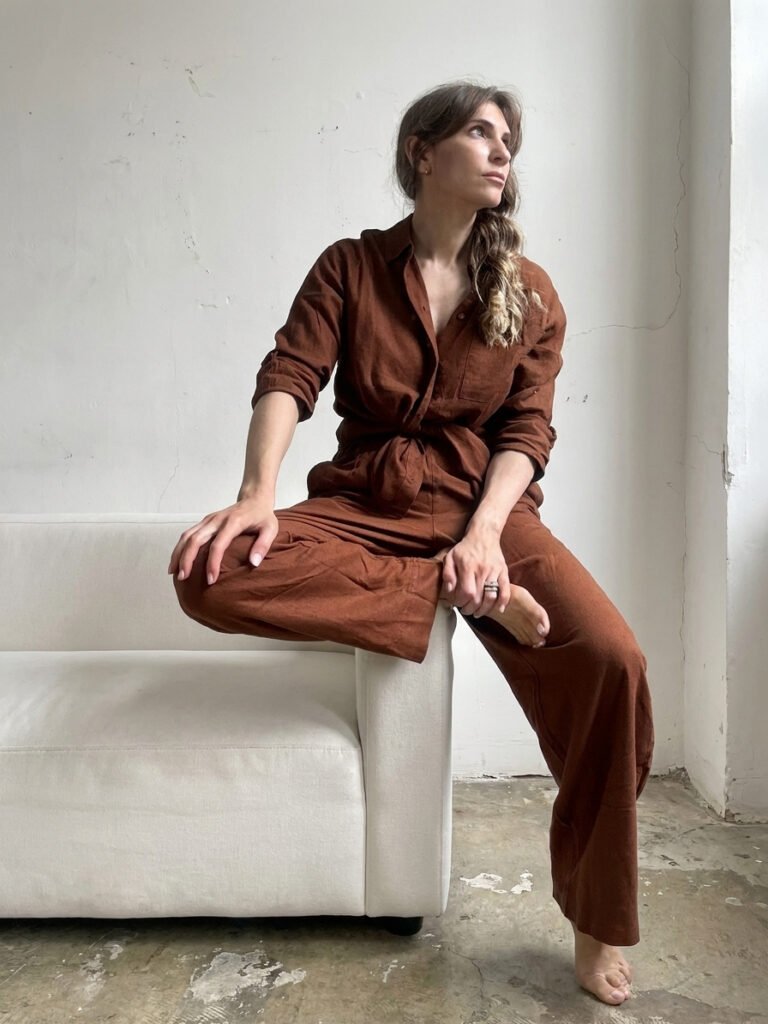
Rugs as sculptural form.
Form, texture, and material are explored through weaving, creating pieces that invite attention, presence, and engagement with the space they inhabit. Felt underfoot, experienced through the body, seen in the depth of fibers, and sensed in the subtle aroma of natural wool and dyes, our textiles transform ordinary spaces into places of quiet reflection and connection.
After completing my MA in Sculpture at the Royal College of Art, I realized sculpture is more than tridimensional physicality—it is a methodology for thinking, making, and seeing. This perspective led me toward textiles. This period became a pivoting point in my life. I needed to simplify. I wanted to get closer to materials, the making, the essential core of what I had researched academically—stripping away everything unnecessary. A paradox, since my work was about the ornament. The connection I was seeking lived not in theory, but in the collective making, in materials with tradition, and in the quiet strength of what is handmade.
Traveling to the dry forests of Northern Argentina, I met the weavers whose craft had long drawn me. What I found was more than technique—it was resilience, patience, and a rhythm attuned to nature’s cycles. Amaina was born from that encounter, bridging my sculptural practice with ancestral craftsmanship, creating textiles that carry both artistic inquiry and deep cultural heritage.
If you would like to know more about me and my work you can follow this link
Textiles that invite reflection through material and form.
Our crafts
Our commitment to sustainability is woven into every step of our process. Each rug is handcrafted from 100% natural materials, supporting artisan communities and preserving traditional techniques.
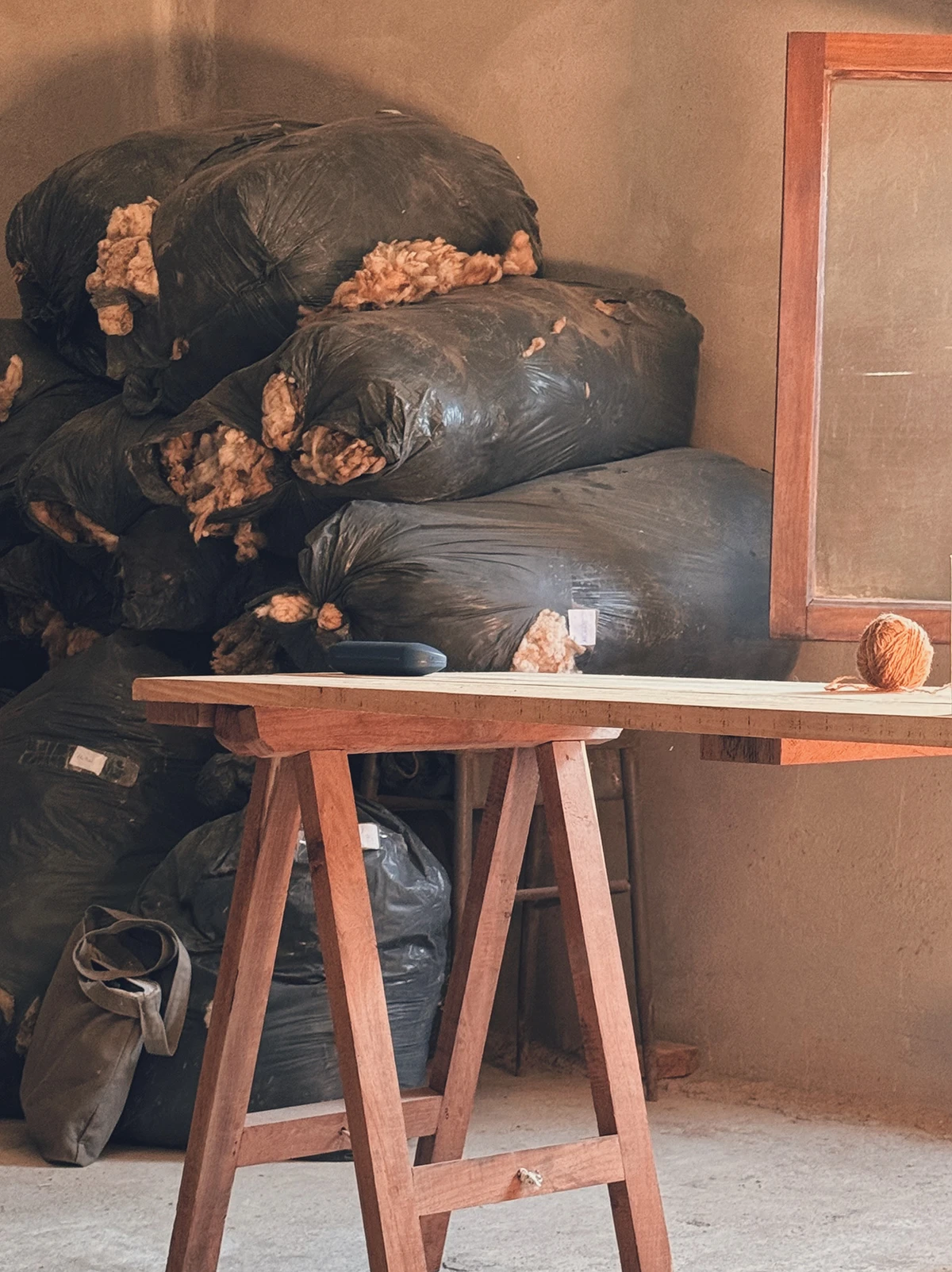
Sourcing the wool
Every piece begins by locally sourcing the fiber—chosen not only for its quality, but for the story it carries. Once selected, the wool is spun by hand. Some yarns are fine and delicate, others thick and robust—each twist shaping the final texture, durability, and character.
We work primarily with two types of sheep’s wool. Criolla wool is textured and resilient, its natural tones echoing the landscape. Corriedale wool is smoother and softer, processed by either a combing or carding process yet spun by hand to retain its artisanal quality.
Our llama throws follow the same process but are its fibers and making takes place in the Puna of Argentina. Some yarns are kept in their natural colors while others go through the dyeing process.
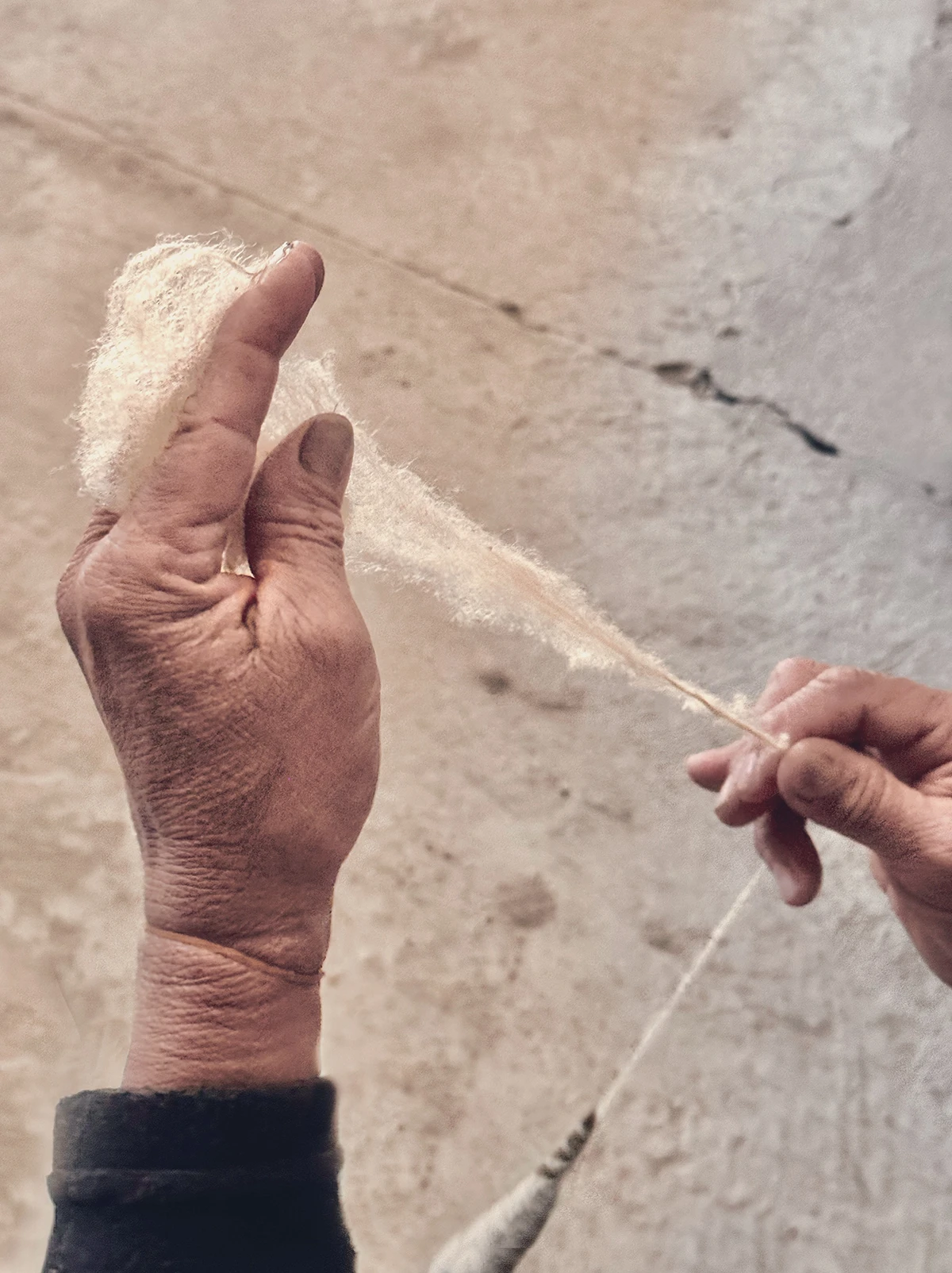
Spinning
The fleece is transformed into yarn, drawing and twisting the fibers by hand. This can be done on a spinning wheel or with a spindle, a stick-like tool—each weaver chooses between them according to her own rhythm and preference.
Once the singles are spun, they are plied—twisted together with another strand to create a stronger, balanced yarn. This second step defines the texture, durability, and character of the wool, transforming individual threads into material ready for weaving.
Every twist, every turn of the spindle is guided by intuition and generations of accumulated knowledge. It is a quiet, meditative process that connects the weaver’s hands to ancestral wisdom, shaping raw material into threads that will carry stories into new spaces.
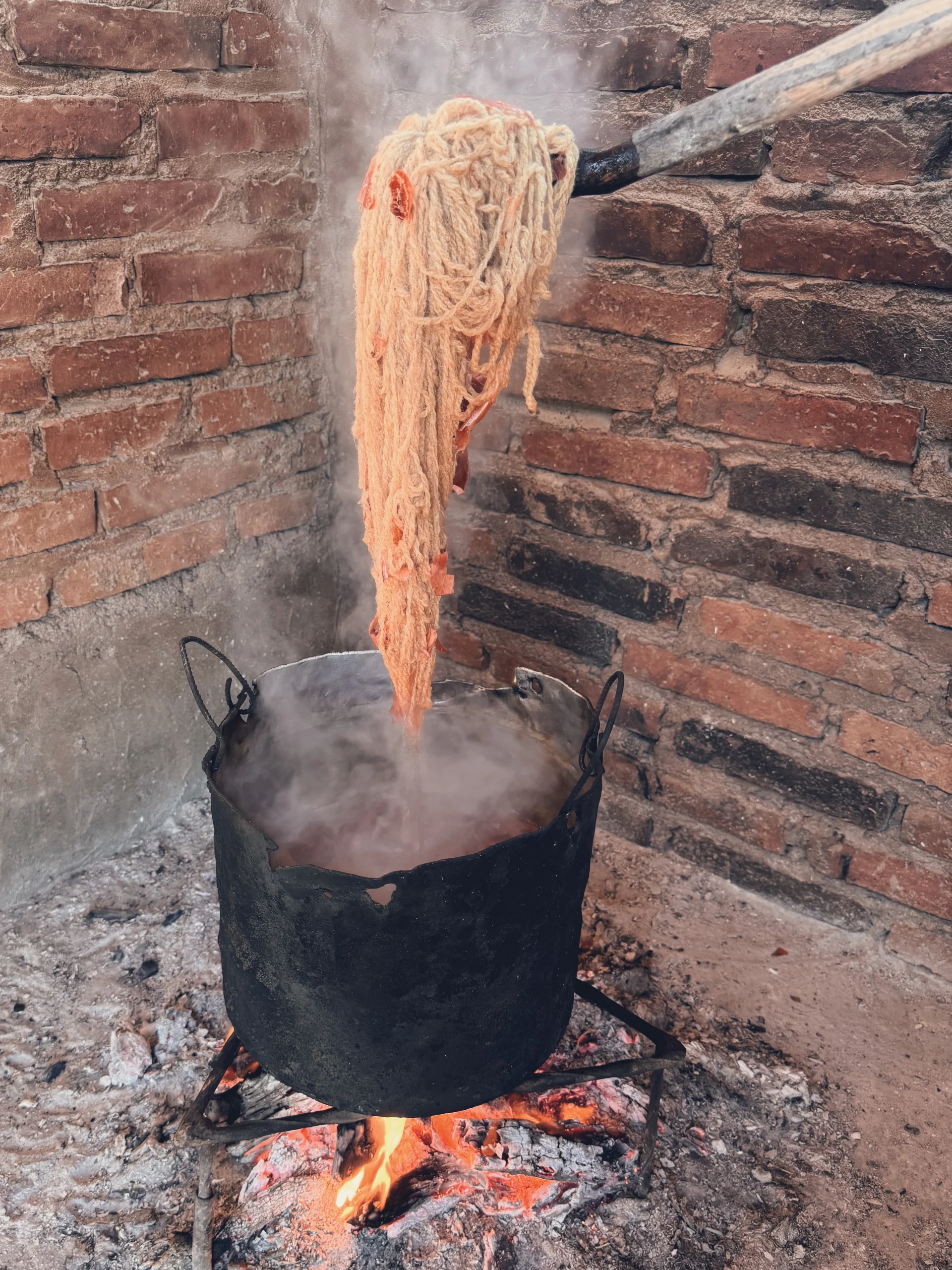
Dyeing
In the dry forest, dyeing wool follows traditions passed down through generations. Artisans gather plant materials for their textiles: carob tree bark for rich browns, onion skins that create warm yellows, and wild chamomile for green tones, to mention a few.
Before dyeing, wool is mordanted with natural mineral salts to hold color permanently. Small batches are simmered over wood fires, each hue requiring careful timing and attention.
Thread by thread, the fibers absorb the dry forest’s essence, carrying its landscape into your space.
Authenticity, sophistication, and respect for the earth.
Ancient Techniques, Living Traditions
In the dry forest of northern Argentina, weaving has been part of local communities for centuries, adapting to new materials while maintaining its ancestral rhythm. The telar criollo, a simple horizontal wooden loom, already existed in the region before colonization, evolving from Indigenous backstrap looms. Its horizontal form allows the weaver to sit close to the textile, connecting body, hand, and thread in every movement.
The major transformation came with the introduction of sheep and wool, which gradually replaced the cotton and camelid fibers previously used. Wool is sheared, hand-spun on a spindle or spinning wheel, and then warped directly onto the loom. With heddles separating the warp threads, the shuttle carries the weft back and forth, and the cloth grows line by line. Patterns are counted, not drawn, held in the weaver’s memory and repeated by hand.
For generations, this technique produced ponchos, mantas, fajas, and the large frezadones—heavy woolen blankets made to keep rural homes warm. These frezadones, with their scale and weight, are the direct ancestors of the rugs now woven by Amaina’s artisans. Using the same loom and gestures, their work extends into rugs, cushions, and throws. The forms may shift, but the language remains: carefully prepared wool, colors drawn from the dry forest, and a textile practice that carries the memory and landscape of the region.